
New Delhi [India], March 03: Social media is no longer just a branding tool. For many businesses, it has become the primary channel for visibility, audience engagement, and customer acquisition. Whether it is a startup trying to build recognition or an established company protecting its digital presence, everyone is competing for attention online. But gaining attention today is not easy. Organic reach has declined across major platforms. Algorithms prioritize momentum. Millions of posts are uploaded every hour. In such a competitive environment, businesses are actively looking for structured solutions like an smm panel to support their digital growth strategy. The conversation is shifting from ‘how to post more’ to ‘how to perform better.’ The Algorithm-Driven Landscape Modern social media platforms rely heavily on algorithmic systems. These systems measure early engagement signals such as likes, shares, comments, watch time, and interaction speed. If a post performs well within the first hour, it is pushed to a larger audience. If engagement is slow, visibility drops quickly. This dynamic has created a performance gap. Even strong content can struggle if it fails to gain early traction. Marketing teams now understand that success depends not only on quality but also on timing and distribution. That is where a professional smm panel becomes part of the strategy. It helps ensure posts receive structured engagement support during critical launch windows. As competition increases, businesses are becoming selective. They no longer choose services randomly. Instead, they search for the best smm panel that offers reliability, safety, and operational transparency. Reliability and Consistency Campaigns are planned carefully. Delays in delivery can disrupt product launches or promotions. A dependable platform ensures that engagement support aligns with marketing timelines. Natural Growth Patterns Sudden spikes can harm credibility. Businesses prefer controlled and gradual growth that aligns with organic audience expansion. Multi-Platform Support Brands are active on Instagram, YouTube, TikTok, Facebook, Telegram, and more. Managing engagement across all platforms from one dashboard increases efficiency. Reporting and Analytics Agencies especially require performance tracking. Clear data builds client trust. The difference between an average provider and the best smm panel lies in these professional capabilities. Agencies Are Leading the Shift Digital marketing agencies face intense pressure to show measurable results. Clients expect numbers — follower growth, engagement rates, and increased visibility. Posting content alone is no longer enough. Agencies combine creative production, paid advertisements, influencer collaborations, and structured engagement systems. An organized smm panel allows them to stabilize performance during high-traffic campaigns. Within the industry, platforms such as TNT SMM are often discussed among agencies as part of a broader digital support system that complements content marketing efforts. The goal is not artificial growth. It is performance management. Small Businesses Are Entering the Space This trend is not limited to large agencies. Small businesses are also adopting these systems. For a new brand, first impressions matter. A social profile with low engagement may appear inactive or untrusted. Customers often judge credibility within seconds. An smm panel can help new businesses create initial momentum. When a profile looks active, real users are more likely to interact. This psychological effect is powerful in digital commerce. Social proof influences purchasing behavior more than ever before. Strategic Integration, Not Random Orders The market has matured significantly. Brands are no longer placing random orders. Instead, they integrate engagement support into campaign planning. For example: ● During a product launch, early engagement is scheduled. ● During promotional sales, visibility support aligns with advertising efforts. ● During collaborations, momentum is maintained across multiple posts. This structured approach makes campaigns more predictable. The best smm panel platforms allow users to control order
Category: Uncategorized
-

Will AI destroy capitalism?
In 2024 we saw the beginnings of ‘reasoning over long chains of thought’. Next the most competent of the AI tools began to pop up inside the applications we use on our computers. And then we entered the ‘agentic’ phase. LLMs have moved from basically ‘ask me and I give you an answer’ to ‘set me a task and leave me to it’ and ‘by the way I may interact with another AI to do it’. Right now, the AI tools that are sparking fantasies of mass unemployment among the skilled salariat are Claude Code and Claude Cowork, both of which are applications that run on your computer, can see your files and make new ones, and can use your screen. Claude Code lets the AI write software and, though its product has been judged patchy, on some tests it scores 92% against a benchmark for competence on basic tasks. Cowork has wowed non-coders because, even in its early iteration, you can use it like a digital AI employee. Unlike their predecessors, these products no longer need to store their reasoning in their working memory: it’s as if the intelligence now has a hard drive. Suddenly, two sets of people – software engineers and office workers – can see how a machine might replace them, and experience how rapidly the agents learn. To inhabit the communities around these agentic AIs – with Gemini, Claude and ChatGPT being the big three at present – is to meet once again the wide eyed euphoria that was generated by the first Internet browsers, and before them, by email. To get a sense of both the hype and fear that it’s generating, one blogpost predicting mass graduate unemployment and an economic slump by 2028 has garnered more than 22 million views. In ‘The 2028 Global Intelligence Crisis’, the consultancy Citrini Research predicts an AI-driven economic and financial boom over the next two years, as productivity rockets, followed by a techno-slump. Once the layoffs began, says the author, in an imaginary report written in October 2028, ‘It was a negative feedback loop with no natural brake. The human intelligence displacement spiral. White-collar workers saw their earnings power (and, rationally, their spending) structurally impaired. Their incomes were the bedrock of the $13 trillion mortgage market – forcing underwriters to reassess whether prime mortgages are still money good.’ In the scenario, the slump happened because the layoff cycle in software and business services spills over into everything that is not manual work. Firms that were paying gazillions for bespoke software decide to build it themselves. Firms that were essentially selling consultancy and management expertise on top of enterprise computer programmes found machines doing their work instead. But that’s just the start. Since much of the consumer economy in the west is based on exploiting the asymmetry of information between for example, customers and supermarkets, or bank account holders and credit card companies, suddenly everyone has the equivalent of Martin Lewis in their pockets. All the GoCompare-type sites disappear and the same happens in business-to business relationships. Friction, basically, evaporates, and with it the monopoly profits of everyone except the AI companies. Software engineers fight each other for welding jobs. Everyone downsizes. It’s like 2008 all over again but it never stops, because the real economy is tanking faster than the financial sector. As someone who has written books on the intertwined long-term fates of information technology and capitalism, it gladdens my heart to see the techno-elite panic about the future. But I am less worried about the doom scenario than they are. First, because in the short-term
-
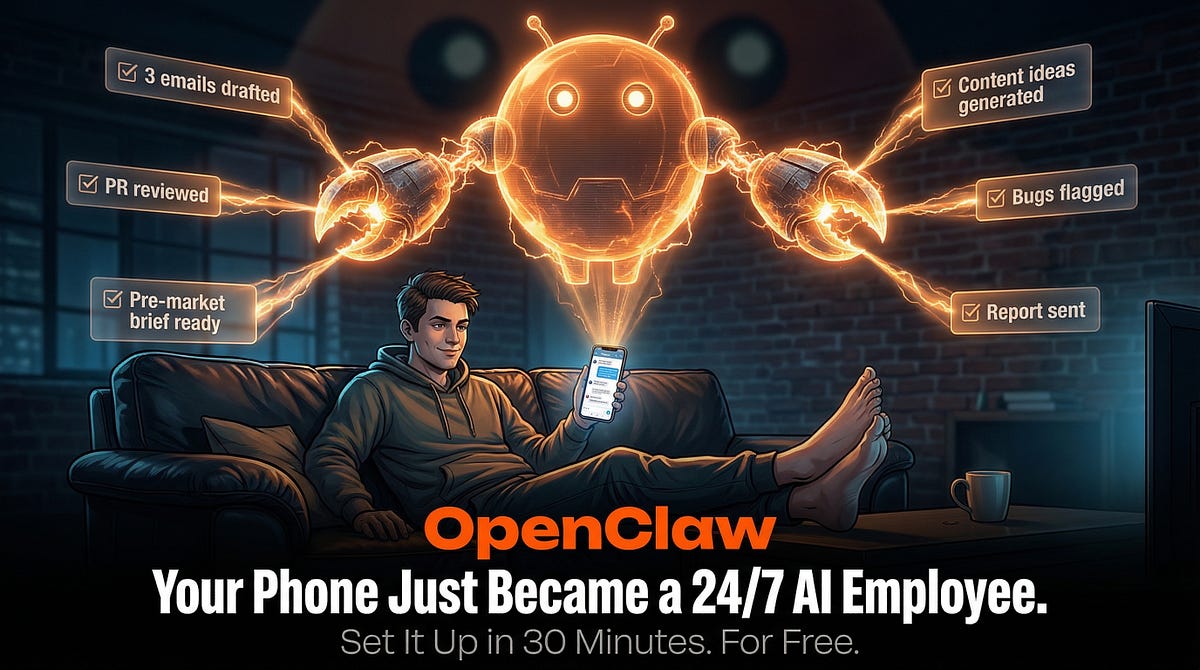
OpenClaw: Your Phone Just Became a 24/7 AI Employee. Here’s How to Set It Up in 30 Minutes For Free
Member-only story OpenClaw: Your Phone Just Became a 24/7 AI Employee. Here’s How to Set It Up in 30 Minutes For Free
247,000 developers already have an AI that acts without being asked. This is the guide they wish existed on day one.
Anup Karanjkar
19 min read
· Just now
Just now
—
Share
📖 Estimated read time: 12 minutes
Two developers. Same tool. Completely different results.
The first installed OpenClaw, chatted with it for ten minutes, thought ‘neat,’ and went back to doing everything manually.
The second spent one evening reading the right things, configured it properly, and now starts every morning to find a Telegram briefing — code reviewed, emails triaged, market data structured — all completed while they slept.
Same tool. One evening of difference. Completely different working life.
This article is the guide the second developer had. By the end, you will have a persistent autonomous agent running on hardware you own, reaching out to you proactively through your phone, and costing anywhere between zero and twenty dollars a month depending on how hard you want to push it.
Let’s get into it. -
Does the Iran War Put America First?
Skip to contentSkip to site index new video loaded: Does the Iran War Put America First? transcript Does the Iran War Put America First? How the antiwar right sees Trump’s foreign policy. This Is why the administration is so vulnerable to the criticism that this is so similar to Iraq — Because it is so similar to Iraq. So whatever happened to America First? ‘Today, the United States military continues to carry out large scale combat operations in Iran.’ It doesn’t feel like a war with Iran was quite what Donald Trump campaigned on in 2024. ‘We’re going to end these endless wars. Endless wars. They never stop. Do you ever see these wars? They go on for 14 years. 20 years.’ And my guest this week thinks it’s a big betrayal of the voters who put him in the White House. Curt Mills, welcome to Interesting Times. Thanks for having me. Thanks for being here. So I’m going to do some stage-setting here for anyone in the audience who doesn’t follow all of the ins and outs of right-wing foreign policy debates. But you are in charge of The American Conservative magazine, which is a magazine founded by Pat Buchanan, among other people, in opposition to the looming Iraq war. And for a long time, The American Conservative was a pretty lonely voice for foreign policy restraint, a kind of antiwar, anti-imperial conservatism. But throughout the Trump era, it’s been seen as much more influential — maybe closer to what Trump himself believes. But here we are. The U.S. is at war, and it is a war. It’s not a, whatever, a large-scale combat operation. We’re at war with Iran. We’re still backing Ukraine in its ongoing war with Russia. We’ve intervened in Venezuela. We’ve intervened in Nigeria. There’s a long list. So, whatever this looks like, I would not describe it as a dovish or restraint-oriented administration. And however you would describe your faction on the right — you can call it anti war MAGA. We can call it America First. Whatever label you want to use seems to be losing. So give me a big picture account of why that’s happened. Why, in the broadest sense, the second Trump administration turned out to be much more hawkish than a lot of people expected? It seems pretty clear to me that the ultimate deciding factor is the president’s personality, and own determinations. There are a number of people in this administration — there are real cadres — that believe in non-interventionism. They were put into personnel throughout the administration, in a much more pronounced way than in term one. This generation is younger, I think, very notably at the cabinet level, but also at the sub-cabinet level. There was every indication that when Trump came in first day of term two, first month of term two — that they really wanted to get the ball rolling on a number of these endeavors. In fact, they tried before he was even in power. The president’s special envoy, Steve Witkoff — if you remember, the transition in mid-January 2025 — imposed a ceasefire on the Israelis that was very unpopular among the Israeli right. Trump opened up negotiations and announced it side by side with Benjamin Netanyahu, with Iran in April of 2025. Vice President Vance led a caustic showdown with Zelensky in February of 2025, indicating the administration was going to take a hard line in getting out of the war. Even on pet projects of people like Secretary of State Marco Rubio, there was every indication that there
-

China’s OEMs: From car manufacturers to AI and robotics companies
Related Vendors “We are no longer an automaker,” says Li Auto. Geely aims to become the “largest robot manufacturer in the world,” while Xpeng is building humanoid robots. About 20 Chinese OEMs are focusing on the convergence of the automotive and robotics industries. According to the manufacturer, the new Li L9 is no longer a car, but embodies artificial intelligence. In recent years, some automotive suppliers have preferred to be perceived as “technology companies.” Are we now entering a phase where OEMs no longer want to be seen as automakers? The new L9 is no longer considered a car but embodies artificial intelligence (known as embodied AI or physical AI), according to Li Auto. Chery states that it wants to become a “global AI technology company.” And Geely plans to become the “largest robotics manufacturer in China and the world.” The convergence, or merging, of the automotive and robotics industries is currently accelerating significantly in China. The reason is advancements in AI models and the hardware that can be used to implement them. More Than a Car Li Xiang, the founder of Li Auto, published a lengthy essay on his Weibo account earlier this month, one of the social media platforms in China. The new SUV from his company, which will soon be launched, is “not just a good car but a masterpiece of embodied AI.” He detailed the various features of the car that have been fundamentally changed with the help of AI. From the intelligent cockpit, where the AI recognizes the driver and their mood, to the assistance systems and the chassis, everything is new. The new car has become “an active partner rather than a passive tool,” according to Li. It recognizes the user, understands them, and proactively fulfills their wishes. He described the L9 more as a type of “companion robot” than as a vehicle. “Every family deserves to have such an intelligent companion.” Li Xiang stated that the positioning of his company has changed. They are no longer an automaker but rather an “AI technology company focused on future mobility.” Geely Establishes Subsidiary for AI Geely has also recently joined this trend. The group has consolidated several AI departments in its new subsidiary, Afari Qianli Intelligent Driving, based in Chongqing, and is significantly expanding the team there. On one hand, AI-supported assistance systems are being developed there, such as the recently introduced “G-ASD.” On the other hand, the same AI models that enable autonomous driving functions in cars are intended to be utilized for controlling robots. The company sees great synergies in this (as previously reported). Geely has the potential to “transform from an automaker into the largest robotics company in China and even the world,” said Li Chuanhai, head of Geely Automobile Group and president of the Geely Automobile Research Institute, at a recent industry conference in Shanghai. Xpeng: AI-Defined Car The Chinese electric vehicle startup Xpeng was one of the pioneers in the transformation of automakers into AI companies in China. The company’s founder, He Xiaopeng, referred to his new car model, the P7+, as the “world’s first AI-defined car” back in November 2024. “In traditional cars, ‘premium’ was defined by design and certain features, but in the era of AI-defined vehicles, true premium quality is inseparably linked with intelligent technology,” said He Xiaopeng just over a year ago. At that time, many received the Xpeng CEO’s announcements with skepticism, as they sounded too much like marketing or PR speak. However, he apparently took it very seriously and began investing heavily in AI and robotics. By the end of this year, Xpeng plans
-

Police chief ‘absolutely determined’ to learn lessons from Maccabi away fans ban
Acting Chief Constable Scott Green issued a full and sincere apology in January for failings identified by His Majesty’s Chief Inspector of Constabulary, including an ‘AI hallucination’ contained in a police report submitted to Birmingham’s Safety Advisory Group (SAG). Maccabi supporters were barred from travelling to a Europa League game at Villa Park in November, following an SAG decision which cited safety concerns based on a report prepared by the West Midlands force. Acting Chief Constable Scott Green, of West Midlands Police (Matthew Cooper/PA) The Chief Inspector of Constabulary’s review, published two days before the retirement of former chief constable Craig Guildford, found eight ‘inaccuracies’ in the police report and said it had overstated Maccabi supporters’ role in disorder in Amsterdam in 2024. The inaccuracies included a reference to a non-existent game between Maccabi and West Ham, said to have been produced by Microsoft Copilot. During media interviews on Wednesday, his first since taking over from Mr Guildford, Mr Green said: ‘On my first day in office I took three important steps. ‘The first one was to apologise for the damage that West Midlands Police had caused to the confidence that the public have in us and particularly to the groups affected. ‘The second thing that I did was I did an immediate voluntary referral to the Independent Office of Police Conduct about the conduct of the officers and staff involved, in particular the senior officers in that decision-making. ‘And then the third thing that I did was launched an operation called Operation Strive, which is our recovery plan to make sure that we learn all of the necessary lessons from the planning and policing of that fixture.’ Asked what practical steps he had taken to learn lessons from the handling of the fixture, the Acting Chief Constable said: ‘One of the first things that I did within my first week is met with a number of members of the community, particularly the Jewish community. ‘I spent last week at a community iftar event listening to our Muslim community. A large-scale policing operation took place for the Aston Villa-Maccabi fixture (Jacob King/PA) ‘I’m doing the same thing at the end of this week to draw the lessons and experiences from the communities.’ He added of the two ongoing inquiries into issues surrounding the decision to ban Maccabi supporters: ‘One of the challenges with this is, of course, there are still two reports to be published, so I do need to be careful what I say. ‘I don’t want to prejudice those reports and I don’t want to be unfair to the officers and staff that might be subject of investigation. ‘What I’m clear on, though, is that the force should have engaged with communities more in the run-up to the decision-making, and we should have been more precise with our use of intelligence. ‘I am absolutely determined that the force will learn its lessons from it.’ He said of the AI-powered Copilot assistant: ‘I took the decision within my first day to turn it off. It was a limited pilot. ‘We’re still scoping some of the lessons that are being learned, and until in particular the Independent Office of Police Conduct have given their view on it, we’re going to leave it switched off for the time being. ‘What I’m clear on, though, is that artificial intelligence, AI, forms part of all of our lives. It will form a part of all of our working lives. Police officers watch over protesters outside Villa Park during Maccabi’s Europe League visit to Birmingham (Joe Giddens/PA) ‘We do actually already use AI in
-

Rival parties agree to pass bill this week to clear way for US investment under trade deal
SEOUL, March 4 (AJP) – A bill outlining South Korea’s massive investment pledges to the U.S., a follow-up measure to a tariff-related deal between the two countries is expected to pass at the National Assembly later this week.
Lawmakers from the ruling Democratic Party (DP) and the main opposition People Power Party (PPP) met on Wednesday to discuss the bill and agreed to put it to a vote at a parliamentary session on Thursday.
“If all goes as planned, we expect the bill to pass,” the DP’s Cheon Jun-ho told reporters. “We put the broader national interest first, mindful that further delays could invite even harsher U.S. tariff measures,” said the PPP’s Yoo Sang-beom.
In January, U.S. President Donald Trump threatened to raise reciprocal tariffs on South Korea back to 25 percent from 15 percent, complaining about delays in Seoul’s legislative process for the trade deal that was reached during his visit to South Korea last fall.
Meanwhile, the two rival parties failed to reach a consensus on another bill to merge several central and southern provinces including Daejeon and Daegu, as each side weighs what advantages it might gain ahead of local elections slated for early June.
Song Seung-hyun 기자 songsh@ajunews.com
★관련기사
– Copyright ⓒ [아주경제 ajunews.com] 무단전재 배포금지 – -

Great Lakes Retirement Inc. Acquires Shares of 10,379 Micron Technology, Inc. $MU
Great Lakes Retirement Inc. bought a new stake in Micron Technology, Inc. (NASDAQ:MU – Free Report) during the 3rd quarter, according to its most recent filing with the Securities and Exchange Commission. The firm bought 10,379 shares of the semiconductor manufacturer’s stock, valued at approximately $1,737,000. A number of other institutional investors have also modified their holdings of MU. REAP Financial Group LLC purchased a new position in Micron Technology in the 3rd quarter valued at $25,000. Barnes Dennig Private Wealth Management LLC purchased a new position in Micron Technology during the 3rd quarter worth $27,000. Cullen Frost Bankers Inc. lifted its stake in shares of Micron Technology by 79.3% in the 3rd quarter. Cullen Frost Bankers Inc. now owns 199 shares of the semiconductor manufacturer’s stock worth $33,000 after acquiring an additional 88 shares during the period. Howard Hughes Medical Institute purchased a new stake in shares of Micron Technology in the second quarter valued at about $30,000. Finally, Physician Wealth Advisors Inc. increased its stake in shares of Micron Technology by 248.0% during the third quarter. Physician Wealth Advisors Inc. now owns 261 shares of the semiconductor manufacturer’s stock worth $44,000 after acquiring an additional 186 shares during the period. Institutional investors and hedge funds own 80.84% of the company’s stock. Get Micron Technology alerts: Sign Up Micron Technology Trading Down 8.0% Micron Technology stock opened at $379.68 on Wednesday. The stock has a 50-day moving average price of $373.79 and a 200 day moving average price of $257.90. Micron Technology, Inc. has a 52 week low of $61.54 and a 52 week high of $455.50. The stock has a market cap of $427.33 billion, a PE ratio of 36.09 and a beta of 1.50. The company has a current ratio of 2.46, a quick ratio of 1.78 and a debt-to-equity ratio of 0.19. Micron Technology (NASDAQ:MU – Get Free Report) last released its earnings results on Wednesday, December 17th. The semiconductor manufacturer reported $4.78 EPS for the quarter, topping the consensus estimate of $3.77 by $1.01. Micron Technology had a net margin of 28.15% and a return on equity of 22.71%. The firm had revenue of $13.64 billion during the quarter, compared to analysts’ expectations of $12.62 billion. During the same period in the previous year, the company earned $1.79 EPS. Micron Technology’s revenue for the quarter was up 56.7% on a year-over-year basis. Micron Technology has set its Q2 2026 guidance at 8.220-8.620 EPS. Equities research analysts predict that Micron Technology, Inc. will post 6.08 earnings per share for the current fiscal year. Micron Technology Announces Dividend The company also recently declared a quarterly dividend, which was paid on Wednesday, January 14th. Shareholders of record on Monday, December 29th were paid a dividend of $0.115 per share. The ex-dividend date was Monday, December 29th. This represents a $0.46 annualized dividend and a yield of 0.1%. Micron Technology’s dividend payout ratio is currently 4.37%. Insider Activity In related news, EVP Sumit Sadana sold 25,000 shares of the stock in a transaction on Monday, February 2nd. The stock was sold at an average price of $429.89, for a total value of $10,747,250.00. Following the completion of the sale, the executive vice president directly owned 248,021 shares in the company, valued at approximately $106,621,747.69. This represents a 9.16% decrease in their position. The sale was disclosed in a document filed with the Securities & Exchange Commission, which is accessible through the SEC website. Also, Director Teyin M. Liu acquired 11,600 shares of Micron Technology stock in a transaction on Tuesday, January 13th. The shares were bought at an average
-

Some People See Aliens While on DMT. Researchers Want to Find Out What They Can Teach Us
A web of EEG electrodes covered Anton Bilton’s scalp like a jeweled headdress. The machine would map his brain activity while the potent psychedelic dimethyltryptamine, commonly known as DMT, coursed through an IV drip and into his bloodstream. With some trepidation, he waited to be plunged into an otherworldly realm that was familiar, given his many years of psychedelic experience, and yet, as was inevitably the case with every DMT trip, completely new. ‘I didn’t know when they were going to turn it on,’ he says. ‘It was eight minutes of having your head in a guillotine, waiting for it to fucking drop.’ Then, like a rocket ripping out of Earth’s atmosphere, he arrived. And he knew he was being watched—not only by the humans back in the hospital room but also by a panoply of alien beings within the DMT realm itself. The peak of Bilton’s trip lasted about half an hour—considerably longer than a typical DMT experience. (Vaping, the most common mode of ingestion, produces peak effects lasting 10 to 15 minutes.) It was 2022, and he was one of 11 volunteers in the world’s first clinical study with ‘extended DMT,’ nicknamed DMTx, at Imperial College London. The idea had been suggested six years earlier in a paper by neurobiologist Andrew Gallimore and psychiatrist Rick Strassman, which argued that a technology called target-controlled intravenous infusion, originally developed to maintain steady levels of anesthesia during surgery, could be repurposed to prolong the DMT state. For Gallimore, one of the goals behind DMTx is to study an especially strange aspect of the DMT experience: perceived encounters with nonhuman, seemingly superintelligent entities. On March 18, he and a team of experts will launch a new psychedelic retreat center-slash-research facility on the tiny Caribbean island of Bequia aimed in part at establishing sustained, two-way communication with these beings. A ‘SETI for the mind,’ Gallimore calls it, referring to the Search for Extra Terrestrial Intelligence. Called Eleusis, the facility is named after an ancient Greek city that once attracted spiritual pilgrims for the ritual consumption of what some experts believe was a psychedelic potion. DMT is currently a Schedule 1 drug in the US, the federal government’s most tightly controlled category, but it can be administered legally in Bequia by licensed care providers. Eleusis’ research wing will be overseen by Noonautics, a nonprofit headed by Gallimore which ‘explores the edges of human understanding,’ according to its website, while the therapeutic side will be managed by Charles Patti and Christina Thomas, a couple who also co-own a ketamine clinic in Florida. (While the therapeutic potential of DMT hasn’t been as rigorously studied as that of some other psychedelics, it has shown promise for the treatment of alcohol use disorder and major depressive disorder.) DMTx sessions will be available to Eleusis guests (the resort is expecting to host 30 this month) under the supervision of medical experts, and alongside a plethora of new-agey offerings like breathwork and sound healing. All applicants will be prescreened to exclude anyone with ‘clear contraindications such as certain cardiovascular conditions, unmanaged psychiatric disorders, or medication conflicts,’ says Thomas. The Eleusis experience—starting with a four-day package costing $9,500 and including two DMTx sessions, lodging, and food—is promoted as a more personalizable and manageable alternative to ayahuasca, which in addition to lasting several hours can also be a physical ordeal and, like any psychedelic, sometimes end up in a terrifying trip. In the Amazon, where some experts believe ayahuasca has been used by indigenous peoples for millennia, the physical and psychological discomforts caused by the potion are viewed as important components of
-
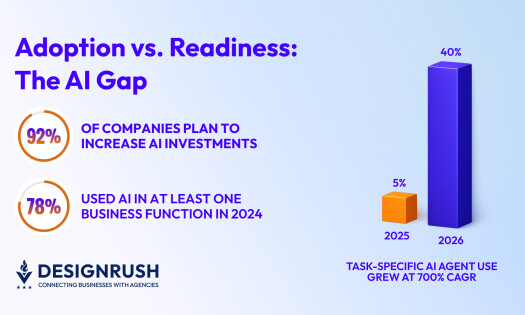
AI Agents Are Now Business Infrastructure: Experts React to AWS Strategy
AWS AI Agents as Infrastructure: Key Findings AI agents are shifting from tools to infrastructure, embedding directly into business operations and changing how work gets done. This shift unlocks scale for SMBs and agencies, enabling small teams to automate key tasks without increasing headcount. Enterprise adoption is accelerating, with 40% of applications projected to include task-specific agents this year, making agentic AI a core part of modern business systems. At AWS re:Invent 2025, Amazon didn’t just unveil product demos or features. Instead, the focus was on how critical AI agents are becoming to how work gets done. By the end of 2026, 40% of enterprise applications will include task-specific AI agents, according to Gartner’s Emerging Tech: The Future of Agentic AI in Enterprise Applications report. Dr. David Yang is a Co-Founder of Newo.ai, a leading no-code platform that helps businesses spin up AI agents in minutes. Yang agrees with AWS’s position that AI agents are quickly becoming central to the future of work. He describes them as infrastructure systems, built to: Respond to customer contacts and schedule tasks and schedule tasks Work around the clock without human intervention human intervention Connect to business tools like calendars and CRMs ‘This shift marks a defining moment for how organizations will approach automation, service delivery, and scale in 2026,’ Yang says. ‘Importantly, it is relevant for agencies and small to medium-sized businesses who are navigating growing demands with limited resources.’ Editor’s Note: This is a sponsored article created in partnership with Newo.ai. Agentic AI in 2026: From Assistants to Infrastructure For years, AI in business has largely meant assistance, where chatbots answered basic questions and automation handled narrow, predefined tasks. AWS has signaled that the old way of using AI is winding down. Its new generation of agents is designed to take on real tasks, move through complex workflows, and stay connected to the systems teams already use. This strategic framing matters as infrastructure is something businesses rely on without thinking about it. It is always on, deeply embedded, and mission-critical. ‘By positioning AI agents this way, AWS is signaling that autonomy, continuity, and decision-making will become standard expectations, not premium capabilities reserved for large enterprises,’ Yang says. What Agentic Infrastructure Actually Means Treating AI agents as part of the core infrastructure, rather than as peripheral tools, marks a meaningful shift in how work is organized. These agents are no longer just responding to prompts. They’re beginning to manage tasks independently by interpreting intent, coordinating across platforms, and completing processes with limited human input. For businesses, this shift moves automation from isolated fixes to integrated systems that operate behind the scenes. Customer inquiries can be resolved across channels, internal workflows can progress without manual handoffs, and operational friction becomes easier to surface and address. ‘This evolution is particularly relevant for organizations that need to scale without increasing complexity,’ Yang says. ‘When agents function as systems rather than tools, efficiency gains compound instead of reaching a plateau.’ How SMBs Are Using AI Infrastructure to Scale While large enterprises have long relied on custom automation and advanced internal tools, the broader impact of AWS’s strategy is what makes it possible for smaller teams. As autonomous agents become easier to launch and manage, the capabilities once reserved for companies with deep technical resources are now within reach for SMBs and agencies. According to Yang, the AI Employee model allows everyday businesses to spin up AI-powered team members in minutes. ‘These agents can manage calls, respond to messages, schedule meetings, and capture leads across channels. In doing so, it helps teams scale service and sales without needing