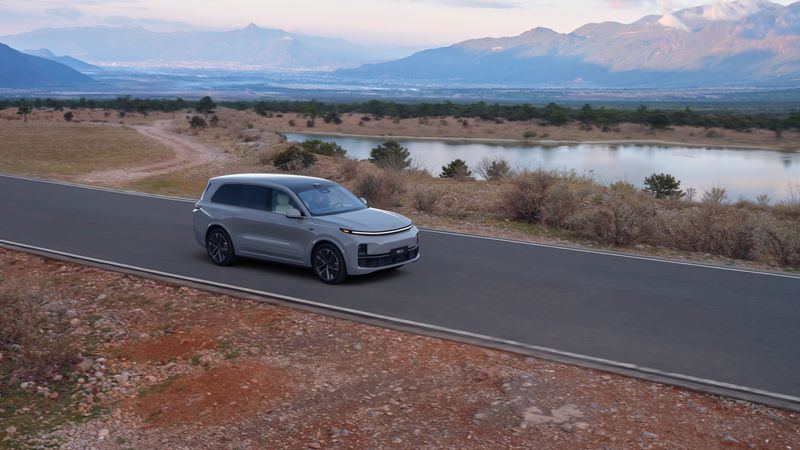
Related Vendors “We are no longer an automaker,” says Li Auto. Geely aims to become the “largest robot manufacturer in the world,” while Xpeng is building humanoid robots. About 20 Chinese OEMs are focusing on the convergence of the automotive and robotics industries. According to the manufacturer, the new Li L9 is no longer a car, but embodies artificial intelligence. In recent years, some automotive suppliers have preferred to be perceived as “technology companies.” Are we now entering a phase where OEMs no longer want to be seen as automakers? The new L9 is no longer considered a car but embodies artificial intelligence (known as embodied AI or physical AI), according to Li Auto. Chery states that it wants to become a “global AI technology company.” And Geely plans to become the “largest robotics manufacturer in China and the world.” The convergence, or merging, of the automotive and robotics industries is currently accelerating significantly in China. The reason is advancements in AI models and the hardware that can be used to implement them. More Than a Car Li Xiang, the founder of Li Auto, published a lengthy essay on his Weibo account earlier this month, one of the social media platforms in China. The new SUV from his company, which will soon be launched, is “not just a good car but a masterpiece of embodied AI.” He detailed the various features of the car that have been fundamentally changed with the help of AI. From the intelligent cockpit, where the AI recognizes the driver and their mood, to the assistance systems and the chassis, everything is new. The new car has become “an active partner rather than a passive tool,” according to Li. It recognizes the user, understands them, and proactively fulfills their wishes. He described the L9 more as a type of “companion robot” than as a vehicle. “Every family deserves to have such an intelligent companion.” Li Xiang stated that the positioning of his company has changed. They are no longer an automaker but rather an “AI technology company focused on future mobility.” Geely Establishes Subsidiary for AI Geely has also recently joined this trend. The group has consolidated several AI departments in its new subsidiary, Afari Qianli Intelligent Driving, based in Chongqing, and is significantly expanding the team there. On one hand, AI-supported assistance systems are being developed there, such as the recently introduced “G-ASD.” On the other hand, the same AI models that enable autonomous driving functions in cars are intended to be utilized for controlling robots. The company sees great synergies in this (as previously reported). Geely has the potential to “transform from an automaker into the largest robotics company in China and even the world,” said Li Chuanhai, head of Geely Automobile Group and president of the Geely Automobile Research Institute, at a recent industry conference in Shanghai. Xpeng: AI-Defined Car The Chinese electric vehicle startup Xpeng was one of the pioneers in the transformation of automakers into AI companies in China. The company’s founder, He Xiaopeng, referred to his new car model, the P7+, as the “world’s first AI-defined car” back in November 2024. “In traditional cars, ‘premium’ was defined by design and certain features, but in the era of AI-defined vehicles, true premium quality is inseparably linked with intelligent technology,” said He Xiaopeng just over a year ago. At that time, many received the Xpeng CEO’s announcements with skepticism, as they sounded too much like marketing or PR speak. However, he apparently took it very seriously and began investing heavily in AI and robotics. By the end of this year, Xpeng plans
China’s OEMs: From car manufacturers to AI and robotics companies
Leave a Reply