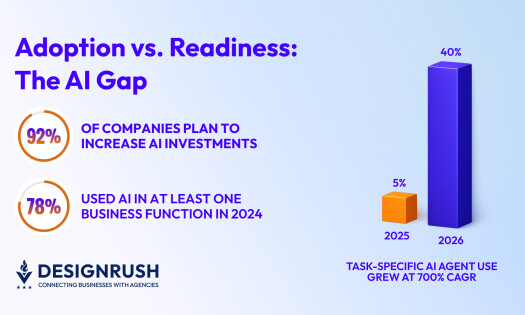
AWS AI Agents as Infrastructure: Key Findings AI agents are shifting from tools to infrastructure, embedding directly into business operations and changing how work gets done. This shift unlocks scale for SMBs and agencies, enabling small teams to automate key tasks without increasing headcount. Enterprise adoption is accelerating, with 40% of applications projected to include task-specific agents this year, making agentic AI a core part of modern business systems. At AWS re:Invent 2025, Amazon didn’t just unveil product demos or features. Instead, the focus was on how critical AI agents are becoming to how work gets done. By the end of 2026, 40% of enterprise applications will include task-specific AI agents, according to Gartner’s Emerging Tech: The Future of Agentic AI in Enterprise Applications report. Dr. David Yang is a Co-Founder of Newo.ai, a leading no-code platform that helps businesses spin up AI agents in minutes. Yang agrees with AWS’s position that AI agents are quickly becoming central to the future of work. He describes them as infrastructure systems, built to: Respond to customer contacts and schedule tasks and schedule tasks Work around the clock without human intervention human intervention Connect to business tools like calendars and CRMs ‘This shift marks a defining moment for how organizations will approach automation, service delivery, and scale in 2026,’ Yang says. ‘Importantly, it is relevant for agencies and small to medium-sized businesses who are navigating growing demands with limited resources.’ Editor’s Note: This is a sponsored article created in partnership with Newo.ai. Agentic AI in 2026: From Assistants to Infrastructure For years, AI in business has largely meant assistance, where chatbots answered basic questions and automation handled narrow, predefined tasks. AWS has signaled that the old way of using AI is winding down. Its new generation of agents is designed to take on real tasks, move through complex workflows, and stay connected to the systems teams already use. This strategic framing matters as infrastructure is something businesses rely on without thinking about it. It is always on, deeply embedded, and mission-critical. ‘By positioning AI agents this way, AWS is signaling that autonomy, continuity, and decision-making will become standard expectations, not premium capabilities reserved for large enterprises,’ Yang says. What Agentic Infrastructure Actually Means Treating AI agents as part of the core infrastructure, rather than as peripheral tools, marks a meaningful shift in how work is organized. These agents are no longer just responding to prompts. They’re beginning to manage tasks independently by interpreting intent, coordinating across platforms, and completing processes with limited human input. For businesses, this shift moves automation from isolated fixes to integrated systems that operate behind the scenes. Customer inquiries can be resolved across channels, internal workflows can progress without manual handoffs, and operational friction becomes easier to surface and address. ‘This evolution is particularly relevant for organizations that need to scale without increasing complexity,’ Yang says. ‘When agents function as systems rather than tools, efficiency gains compound instead of reaching a plateau.’ How SMBs Are Using AI Infrastructure to Scale While large enterprises have long relied on custom automation and advanced internal tools, the broader impact of AWS’s strategy is what makes it possible for smaller teams. As autonomous agents become easier to launch and manage, the capabilities once reserved for companies with deep technical resources are now within reach for SMBs and agencies. According to Yang, the AI Employee model allows everyday businesses to spin up AI-powered team members in minutes. ‘These agents can manage calls, respond to messages, schedule meetings, and capture leads across channels. In doing so, it helps teams scale service and sales without needing
AI Agents Are Now Business Infrastructure: Experts React to AWS Strategy
Leave a Reply