In recent days, JPMorgan Chase restricted lending to private credit providers after marking down several loans, prompting Carlyle and other large asset managers to curb redemptions in key funds amid growing concern about stress in the private credit market. At the same time, Carlyle has advanced complex financing efforts such as ‘Project Potomac’ and continued to streamline its portfolio with moves like the SierraCol sale, highlighting how it is reshaping its balance sheet and funding model while market liquidity worries build. We’ll now examine how concerns over private credit market strain and Carlyle’s redemption limits may influence its existing investment narrative. We’ve uncovered the 14 dividend fortresses yielding 5%+ that don’t just survive market storms, but thrive in them. Carlyle Group Investment Narrative Recap To own Carlyle, you need to believe in its ability to grow fee based, alternative assets while managing liquidity and funding risks across cycles. The immediate swing factor now is how private credit jitters and tighter bank lending affect near term fundraising and realizations, while the biggest risk is that prolonged stress in private credit constrains deal activity and compresses economics. The JPMorgan move is potentially material here because it goes straight to the core of Carlyle’s credit engine. Against that backdrop, ‘Project Potomac’ looks especially important, because it is a large, structured financing tied to Carlyle Partners IX that aims to broaden the firm’s funding toolkit. For shareholders focused on catalysts, the scale and complexity of this collateralized fund obligation could influence how resilient Carlyle’s growth in fee paying AUM and earnings becomes if traditional credit channels remain under pressure, and how it balances liquidity for existing investors with the push into new flagship strategies. Yet behind all this, investors still need to weigh the risk that tighter private credit conditions and any prolonged redemption limits could quietly reshape Carlyle’s fee power and… Read the full narrative on Carlyle Group (it’s free!) Carlyle Group’s narrative projects $5.1 billion revenue and $1.7 billion earnings by 2028. This assumes revenue will decline by 2.6% per year and implies an earnings increase of about $0.4 billion from $1.3 billion today. Uncover how Carlyle Group’s forecasts yield a $66.27 fair value, a 45% upside to its current price. Exploring Other Perspectives Some of the lowest ranked analysts were already assuming only about US$5.1 billion of revenue and US$1.6 billion of earnings by 2028, which is a much more cautious story than the consensus view. If you are worried about private credit stress and fee pressure, their scenario highlights how sharply expectations can differ and why it may be worth comparing several viewpoints before deciding what this latest news could mean for Carlyle’s path from here. Explore 4 other fair value estimates on Carlyle Group – why the stock might be worth over 2x more than the current price! Decide For Yourself Don’t just follow the ticker – dig into the data and build a conviction that’s truly your own. A great starting point for your Carlyle Group research is our analysis highlighting 3 key rewards and 3 important warning signs that could impact your investment decision. Our free Carlyle Group research report provides a comprehensive fundamental analysis summarized in a single visual – the Snowflake – making it easy to evaluate Carlyle Group’s overall financial health at a glance. Curious About Other Options? Right now could be the best entry point. These picks are fresh from our daily scans. Don’t delay: Outshine the giants: these 19 early-stage AI stocks could fund your retirement. AI is about to change healthcare. These 33 stocks are working on everything from early diagnostics
Category: Uncategorized
-
Harry Styles’ Dating History: From Kendall Jenner to Olivia Wilde to Zoë Kravitz
Harry Styles has always been notoriously private regarding his love life. Since rising to fame in One Direction, Styles has been in his fair share of high-profile relationships. Even early into his career, he made headlines for his romance with the late Caroline Flack. Less than a year later, his paparazzi photos with Taylor Swift went viral after the rumored couple was spotted on a date in Central Park. Styles has also been linked to several Victoria’s Secret models, including Kendall Jenner and Camille Rowe. The “As It Was” singer dated his Don’t Worry Darling costar Olivia Wilde for nearly two years after her very public split from Jason Sudeikis. Despite the controversy surrounding their relationship, Styles maintained his stance on keeping his romances private. “I’ve never talked about my life away from work publicly and found that it’s benefited me positively. There’s always going to be a version of a narrative, and I think I just decided I wasn’t going to spend the time trying to correct it or redirect it in some way,” Styles previously told Rolling Stone. After his split from Wilde, the pop star was seen in June 2023 hanging out with actress Taylor Russell before they split the following May. Then, in August 2025, he was romantically linked to actress Zoë Kravitz when the two were spotted on a stroll in Rome; they’ve been spotted together in New York City in recent days ahead of his Saturday Night Live appearance on March 14. Here’s a look back at Harry Styles’ dating history. Felicity Skinner Before Styles was a megastar, he met one of his first girlfriends, Felicity Skinner, through a mutual friend. The two teenagers began dating, despite living in different cities. The couple remained together for almost a year before drifting apart. Looking back on the relationship, Skinner says Styles was a great boyfriend. “He was a really good boyfriend, very romantic and, yes, shy. He was good looking and obviously I found him very attractive. We were together for just under a year … We just clicked straight away and got on really well. He has a really cute smile. We started seeing each other when we were both about 15. He was really sweet. It was puppy love and we were definitely each other’s first loves,” Felicity shared in an interview. Caroline Flack Karwai Tang/WireImage In 2011, Styles was linked with television personality Caroline Flack. At the time, One Direction had recently wrapped their run on The X Factor, and Flack had just begun hosting a spin-off show, The Xtra Factor. The couple, who had a 14-year age gap, went on to date for several months. They split in early 2012, with Styles tweeting that it had been a “mutual decision.” “Please know I didn’t ‘dump’ caroline. This was a mutual decision. She is one of the kindest, sweetest people I know. Please respect that,” Styles posted. Flack looked back on the brief relationship in her 2015 autobiography Storm in a C Cup, where she explained that things had been going well until their romance was made public. It wasn’t long before the public’s scrutiny of their age gap led to the relationship’s demise. ”We were both single, we got on well and we had a laugh. It was only when it became public knowledge that things turned sour. At the beginning it was all very playful. He joked about being attracted to older women. It began to go wrong when Harry was pictured coming out of my house one morning. And once that was out, it was open season. After that
-

Mass Hallucination: Mass Hallucination
Mass Hallucination
(Makeshift Swahili)
Out Now
DL | Cassette
No need for lyrical analysis. No need for thematic detail. No need for anything but three swipes of the spinal cord. Three internal scrapings from the new release by Mass Hallucination. By Ryan-Lewis Walker.
The crack of the neck. And the crack of everything else.
Composed of Chris R and Tom Shuff of Coded Marking, former Cattle bassist Tom Goodall and Will from Self-Immolation Music, and released via Glasgow’s Makeshift Swahili, this eponymous album follows the band’s debut demo from August last year.
This time, although still dedicated to the twitchy contortions of all things that slide in and out of the parameters according to noise, hardcore and post-punk – a sound entirely built to blow nowhere except out, they wanted to produce something that was still just as raw, but a little more polished and song-structured.
First up, Lacerated leans into the flank with a finger instead of knives, yet succeeds in introducing a hole just as deep as any common blade. Bookended with metallic aches of feedback scraping across the dead air in a decaying chamber, its suppurated complexion surges and squeals with cannibalistic action.
It’s soon followed by Human Figures. Cracking apart like a blowtorch to the bosom of a leather settee, it erupts from the shackles in a skin-soldering rush of golem–goading power. Thuds of molten bass, collisions of feral guitars, vocals howling into the abyss, all swallowed by the concave of density and despair.
Finally, in Dragging A Rope we hear a near-perfect synergy of those Negative Approach and Killing Joke influences bleeding through. A tag-team of bass and drums punctuates the battleground whilst humanoid fractures of manic guitars shave with shards of glass elsewhere, ending on an explosion akin to sticks of dynamite strapped to the base of a brutalist building at the interchange of West Yorkshire and Hell.
No need for lyrical analysis. No need for thematic detail. No need for anything.
The crack of the…
~
Mass Hallucination | Bandcamp
Makeshift Swahili | Bandcamp
Ryan-Lewis Walker | Louder Than War -
The Parenting Mirror: What Learning AI is Teaching Me
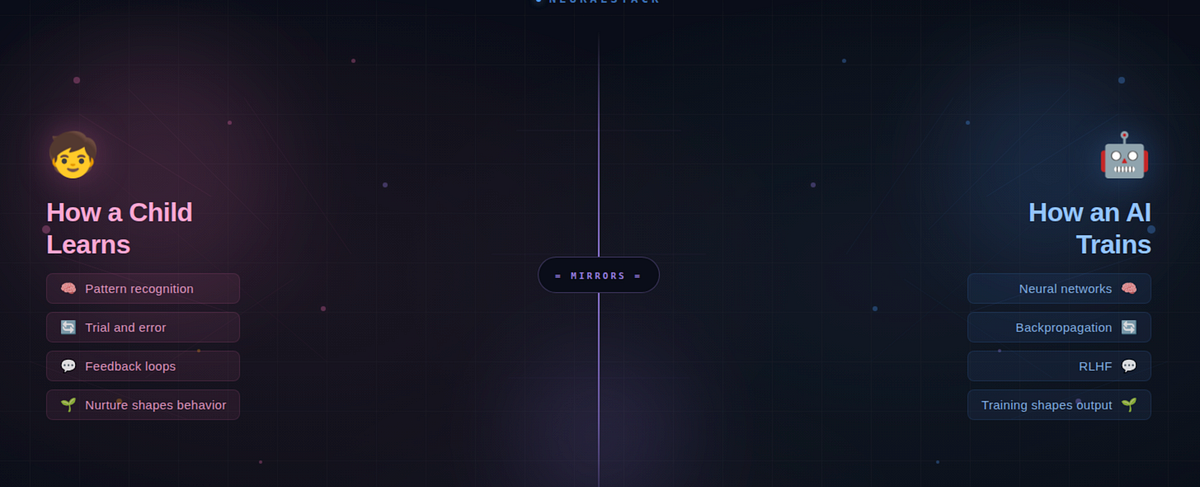
The Parenting Mirror: What Learning AI is Teaching Me Vikas 5 min read · Just now Just now — Listen Share Maybe the best engineers aren’t just good at code. Maybe they’re good at patience. Press enter or click to view image in full size Source : Claude-Generated Punish a child every time they fail, and they stop trying. Praise them for everything, and they never grow. Now replace ‘child’ with ‘AI model.’ The sentence still holds. That’s not a coincidence — it’s the same underlying principle. And once you see it, you can’t ignore it. I started learning AI to build stuff and make my life easy. But somewhere along the way, AI taught me something about raising kids. And watching my kids taught me why AI works the way it does. Let me explain. A Toddler and a Neural Network Walk Into a Dog Park When your toddler points at a Labrador and says ‘dog,’ then points at a German Shepherd and says ‘dog’ again — that’s pattern recognition. Nobody handed them a rulebook. Nobody said ‘four legs + fur + tail = dog.’ They figured it out from examples. Lots of examples. That’s exactly how a neural network learns. You feed it thousands of labeled images — ‘this is a dog,’ ‘this is not a dog’ — and it builds its own internal rulebook. No programmer writes the rules explicitly. The model discovers the patterns from data, the same way your kid discovered ‘dog’ from a hundred visits to the park. And when your toddler points at a cat and confidently says ‘dog’? That’s not failure. That’s learning in progress. They saw four legs, fur, a tail — and made their best guess. In machine learning, this is called backpropagation — a technical term for a simple idea: tell the system where it went wrong, so it can adjust. It’s the machine equivalent of a patient parent saying, ‘Close! That’s actually a cat. See the pointy ears?’ But here’s where it gets deeper. It’s not just that you give feedback. It’s how you give it. The Parenting Mirror Think about three types of parents. Each one maps directly to a style of AI training — and each produces a very different outcome. 🚫 The Punisher: Correct Every Mistake Harshly With a child: They stop exploring. They become anxious. They only give ‘safe’ answers to avoid getting yelled at. Creativity dies. Survival mode kicks in. With AI: This is over-alignment. The model gets penalized so aggressively for any wrong output that it refuses to answer even harmless questions. It’s the AI equivalent of a kid who won’t raise their hand in class because they got scolded once. The model isn’t safe — it’s paralyzed. You’ve probably experienced this. You ask an AI a perfectly reasonable question and get: ‘I’m sorry, I can’t help with that.’ That’s an over-punished model. It learned that saying nothing is safer than risking a mistake. 🧸 The Coddler: Never Say No With a child: They grow up overconfident and fragile. They think every answer they give is correct. They never develop resilience because they’ve never encountered real feedback. With AI: This is the hallucination problem. A model trained with weak or absent correction generates confident, polished, beautifully written responses — that are completely wrong. It doesn’t know it’s wrong because nobody ever told it. Just like a child who was never corrected, it mistakes confidence for competence. 🌱 The Nurturer: Boundaries With Room to Grow With a child: They feel safe enough to fail. They learn from mistakes without fear. They develop judgment,
-

0G Ships Major Infrastructure Upgrade: Geth-to-Reth Validator Migration
San Francisco, CA, March 13, 2026 (GLOBE NEWSWIRE) — 0G (Zero Gravity), creator of the world’s first decentralized AI operating system (dAIOS), today announced a series of infrastructure upgrades across its live Aristotle Mainnet: Sealed Inference for cryptographically private AI compute, the integration of GLM-5 as the highest-ranked open-source model on decentralized infrastructure, and a migration of its validator execution layer from Geth to Reth — the high-performance Rust-based client built by Paradigm. 0G migrates its validator infrastructure from Geth to Reth for enhanced speed and efficiency. Together, these upgrades represent the most significant infrastructure evolution since the Aristotle Mainnet launch in September 2025, strengthening every layer of the 0G stack from consensus to compute. 0G is migrating its validator infrastructure from Go-Ethereum (Geth) to Reth, the modular Rust-based execution client originally developed by Paradigm. The migration brings substantial improvements to sync performance, block execution speed, memory efficiency, and long-term scalability of the 0G network. Why Reth Reth has rapidly become the execution client of choice for high-performance blockchain networks. Written in Rust — a language designed for memory safety and bare-metal performance — Reth delivers measurable advantages over Geth across every major infrastructure metric: Faster sync: BNB Chain reported 40% faster sync times with Reth vs. Geth in production benchmarks. Block execution latency dropped from 25.3ms (Geth p50) to 19.1ms (Reth p50) — a 24% improvement. Lower memory footprint: Reth’s architecture eliminates Go’s garbage collection overhead, resulting in more predictable memory usage and reduced hardware requirements for validators. Modular by design: Reth’s component-based architecture allows 0G to customize and optimize individual execution layers — storage, EVM, networking — independently, enabling faster iteration and AI-specific optimizations. Industry momentum: Base has deprecated Geth entirely in favor of Reth. Optimism is ending op-geth support by May 2026. The industry is converging on Reth as the standard for high-throughput execution. What This Means for the 0G Network For validators, the Reth migration translates to faster node synchronization, lower operational costs through reduced hardware requirements, and improved uptime during peak network loads. For developers and users, it means a more responsive chain layer capable of handling the throughput demands of AI-native workloads — decentralized inference, on-chain settlement, and high-frequency agent transactions. The migration began with the Foundation Validator (Validator 0) infrastructure upgrade completed in February 2026 and is now extending across the network. ‘Geth served us well, but as on-chain AI workloads scale — inference settlement, agent transactions, high-frequency data availability — the execution layer becomes the bottleneck. Reth’s Rust-based architecture gives us the memory efficiency, parallel processing, and modular extensibility we need to stay ahead of that curve. This isn’t just a client swap. It’s rebuilding the foundation for what comes next.’ — Ming Wu, CTO of 0G Labs The Full-Stack Decentralized AI Operating System These three upgrades — Reth validators, Sealed Inference, and frontier open-source model access — reinforce 0G as the only live infrastructure delivering every layer of the decentralized AI stack: 0G Chain: EVM-compatible Layer 1 purpose-built for AI workloads, now powered by Reth 0G Compute: Decentralized GPU marketplace with Sealed Inference — TEE-verified on every call 0G Storage: Decentralized storage delivering up to 2 GB/s throughput 0G Data Availability: 50,000x faster and 100x cheaper than Ethereum DA With over 100 ecosystem partners including Chainlink, Google Cloud, Alibaba Cloud, and Coinbase Wallet, 0G continues to build the infrastructure layer that makes decentralized AI as performant, private, and verifiable as centralized alternatives — at a fraction of the cost. About 0G Labs 0G Labs (Zero Gravity Labs, Inc.) is the creator of the 0G dAIOS — the world’s fastest decentralized AI
-
Tata Motors CV Bags Orders For 5,000 Buses Across India
Tata Motors Commercial Vehicles Ltd. has won a cumulative pan-India order of over 5,000 buses from multiple state transport undertakings, the company confirmed in an exchange filing on Friday.
The order pertains to the delivery of more than 5,000 buses and bus chassis, spanning across various states in India. Each of the tenders was won through a competitive e-bidding process.
Some of the state transport undertakings that have issued orders to Tata Motors include the Maharashtra State Road Transport Corporation (MSRTC), Gujarat State Road Transport Corporation (GSRTC), North Western Karanataka Road Transport Corporation (NWKRTC), Telangana State Road Transport Corporation (TGSRTC), and Bihar State Road Transport Corporation (BSRTC), among others.
The majority of these orders are concentrated around the Southern and Western parts of India, although the Chandigarh and Bihar road transport undertakings have also placed orders.
The cumulative orders would see Tata Motors offer a wide range of vehicles, including Tata Magna, Tata Cityride, Tata Starbus, Tata LPO 1618 and 1622 and LPO 1822, among others. These buses are configured for intercity, long-haul or intracity operations.
‘This recognition by multiple State Transport Undertakings reflects the deep trust placed in Tata
Motors’ mobility solutions. These cumulative orders strengthen our position as the country’s preferred mobility partner and reinforce our commitment to shaping India’s public transport of tomorrow,” said Anand S, Vice President and Head, Commercial Passenger Vehicle Business, Tata Motors Ltd.
Tata Motors has not disclosed the exact value of these cumulative orders. The stock, meanwhile, has fallen more than 4% in trade on Friday, although it is mainly a result of broad-based selling in the market, in the wake of global headwinds.
ALSO READ: Nifty Auto Hits Six-Month Low: TVS, Tata Motors Among Top Drags — What’s Behind The Slump?
Essential Business Intelligence, Continuous LIVE TV, Sharp Market Insights, Practical Personal Finance Advice and Latest Stories — On NDTV Profit. -

AI is dumping 150-page complaints on finance ombud’s desk
What used to take a paragraph or two now comes in book-sized tomes, often with fake legal cases as references. The idea that artificial intelligence (AI) will ease workloads is certainly not happening at the National Financial Ombud (NFO). Complaints that previously would take a paragraph or two are now – with the aid of AI – coming in 150-page tomes, often with fake legal cases as references, says Reana Steyn, NFO CEO and head ombud, speaking at the Conduct Risk Conference in Midrand on Wednesday (11 March). Where the complaints adjudicators would previously look at a paragraph and make a call on whether to investigate further, they are now required to review complaints that sometimes run to 150 or even 200 pages. It’s clear these are drafted using AI. ‘We’re supposed to be a speedy and efficient dispute resolution body. The institution against which the complaint is made is also using AI to reply,’ says Steyn, adding to the ombud’s already stretched workload. Steyn says the ombud takes pain to ensure responses are crafted by humans, not AI. ALSO READ: The frightening AI times we live in False facts being dished up Some of the case law cited in these AI-generated complaints to the NFO are completely fake. This is a problem that has already surfaced on multiple occasions in SA courts (see below). Fake or not, these complaints and the legal citations have to be researched and investigated by the NFO. The ombud says it must strike a balance between consumer advocacy and impartial resolution. About half the credit-related complaints were decided in favour of consumers in 2024. The figure was 25% for life insurance, 12% for non-life insurance and 21% for banking services. The NFO’s 2024 report – released in 2025 – shows nearly 36 000 complaints received between March and December of that year, with 28 000 resolved in the same period. Money recovered The ombud recovered R328 million for consumers, with an average of 115 days to resolve a case. In cases involving the banks, the time to resolve a case is about 52 days. ‘Over the past year, the organisation recovered a staggering R328.5 million on behalf of consumers, a figure that speaks volumes about the power of independent mediation and the tangible benefits the NFO delivers,’ says the 2024 annual report. The NFO was created in 2024 to amalgamate four predecessor ombuds: credit, banking services, long-term insurance and short-term insurance. This makes it easier for consumers to lodge complaints under a single umbrella organisation. The Pension Funds Adjudicator and Financial Advisory and Intermediary Services (Fais) ombud continue to operate independently. ALSO READ: US cybersecurity company invests in SA – but who will benefit? Stats … and additional pressures Steyn says the NFO receives tens of thousands of calls and emails a month. When complaints don’t go the way of the consumer, many take to social media to relitigate their complaints. About 5% of complaints at the NFO come from people over 85, many of whom are less comfortable in a digital environment. The NFO has a policy for vulnerable customers, offering extra duty of care to those in poor health, or suffering financial or other hardships. The Financial Sector Conduct Authority (FSCA) has issued multiple warnings about AI-generated fraud. Scammers exploit AI to create convincing impersonations that lend false legitimacy to unauthorised investment schemes, fake trading platforms, and solicitation of funds via apps like WhatsApp, Telegram, and Facebook. Fake case law dreamed up by AI In one recent case before the KwaZulu-Natal High Court, Judge Elsje-Marié Bezuidenhout issued a stinging rebuke against law
-

$10,000 invested in Droneshield and Woodside shares just 1 week ago is now worth…
The
S&P/ASX 200 Index
(ASX: XJO) closed in the red on Thursday afternoon as the ongoing conflict in the Middle East continues to put pressure on shares across global markets.
Investors are nervous about the repercussions of surging oil prices, and inflation concerns are seeing markets beginning to price in another cash rate hike ahead of the next Reserve Bank meeting.
The majority of stocks on the ASX 200 index closed lower for the day, with the exception of some shares, most of which are in the energy sector.
While investor confidence has dropped across most sectors, some ASX shares are thriving in the current market.
Droneshield Ltd
(
ASX: DRO
) and
Woodside Energy Ltd
(
ASX: WDS
) shares are two that spring to mind.
Image source: Getty Images
If I invested $10,000 in Droneshield shares one week ago, what are they worth now?
At the close of the ASX on Thursday afternoon, Droneshield shares are 3.92% lower at $3.92 a piece. But despite the decline, they’re still 7.4% higher than just one week ago.
That means that $10,000 invested in Droneshield shares just one week ago is already worth an impressive $10,740.
And the great news is that analysts think the stock will keep soaring, too. TradingView
data
shows a strong consensus buy rating for Droneshield shares and a maximum target price of $5. That implies the stock could jump another 27.55%, at the time of writing.
The counter drone technology company was one of the
fastest-growing stocks
on the planet last year.
The company has faced a few headwinds over the past 12 months, but has also won some impressive contracts valued at $21.7 million.
And as geopolitical tensions keep rising, demand for defence assets around the world is climbing higher. I think Droneshield is well-positioned to absorb much of the demand.
If I invested $10,000 in Woodside shares one week ago, what are they worth now?
Woodside shares have rallied over the past six months. The stock is now worth 28.24% more than it was back in September.
At the close of the ASX on Thursday afternoon, Woodside shares were 2.07% higher at $31.05. They’re now 2.14% higher over the past week.
That means that $10,000 invested in Woodside shares just one week ago is already worth $10,214.
TradingView
data
shows analysts are relatively divided about the stock. Of 15 analysts, seven have a hold rating, and another six have a buy or strong buy rating on Woodside shares.
The maximum target price is $33.60, which implies a potential 8.2% upside over the next 12 months.
As Australia’s largest oil operator and producer, Woodside shares are being boosted by
global oil supply concerns
arising from the ongoing conflict in the Middle East.
Given there is no sign of how long volatility will last, it’s unclear whether we can expect demand for shares in the sector to keep climbing or taper off. Some analysts warn that oil prices could keep climbing higher for a while.
The ASX energy sector is the only area that ended in the green on Thursday afternoon. -
Two churches in east Texas trade spaces
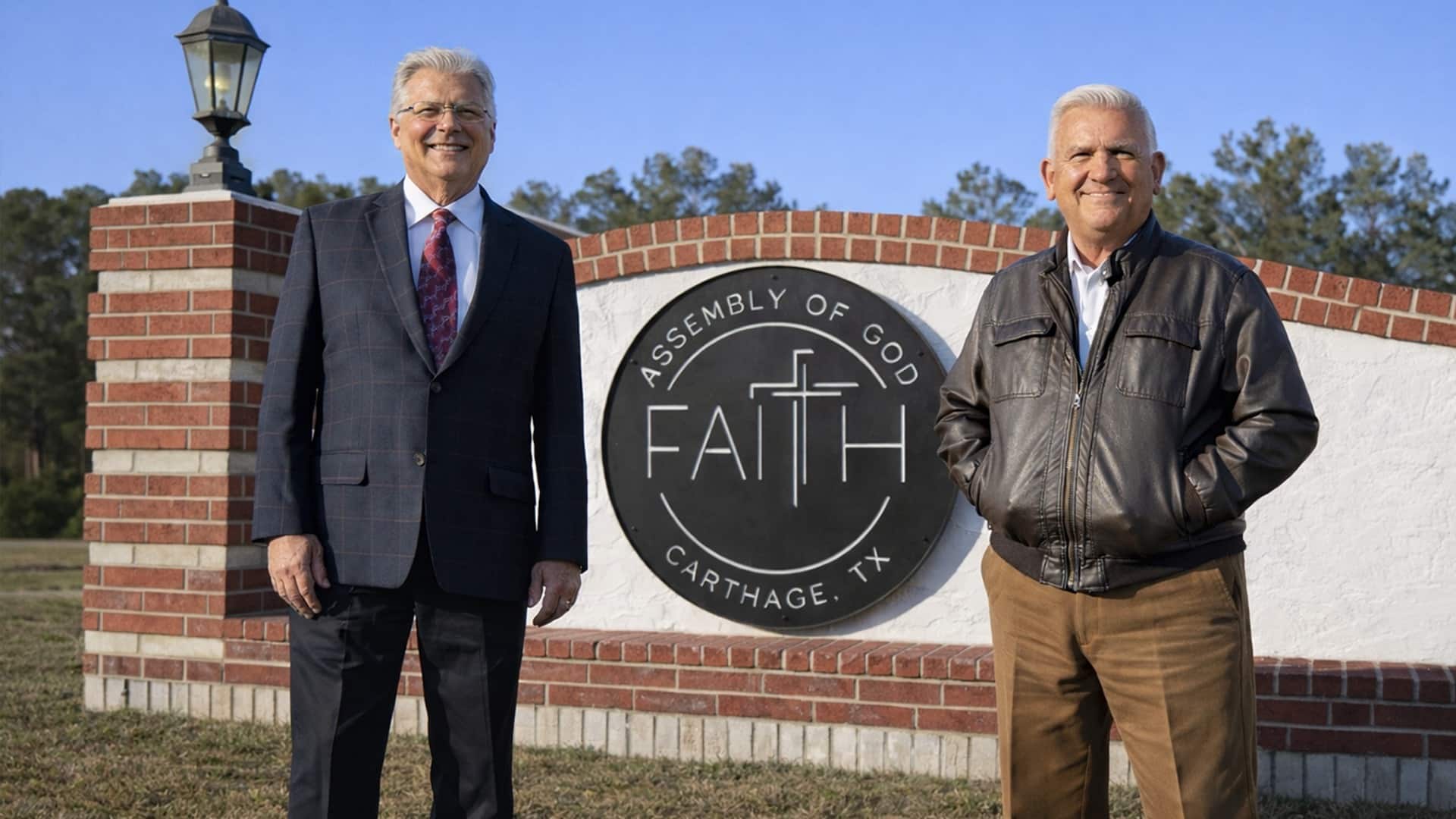
In a move some have called ‘a God moment’ of interdenominational unity, an Assemblies of God church swapped buildings with a Baptist church in a small East Texas town, allowing each congregation to thrive in their new space. Southside Baptist Church (SBC) in Carthage, Texas, was running about 50 people in a 46,000-square-foot building that was draining all the church’s resources, including the congregation’s energy. Kirby Hill, pastor of SBC, noticed Faith Assembly of God outgrowing its space, so he proposed to Senior Pastor David Baze in October 2024 a building swap to better serve both churches. Through God’s direction and a lot of supernatural unity, both boards and congregations voted overwhelmingly to complete the trade. Gaylan Claunch, superintendent for the North Texas District of the Assemblies of God (NTDAG), likened the swap to something rooted in Psalm 118:23, which says ‘this is the Lord’s doing and it is marvelous in our sight.’ Your tax-deductible gift supports our mission of reporting the truth and restoring the church. Donate $50 or more to The Roys Report this month, and you can elect to receive ‘Restory Your Life: How Jesus Reframes Your Past, Rewrites Your Present, and Redefines Your Future’ by Mary DeMuth, click here. Pastor David Baze of Faith Assembly of God. (Photo AG News) Baze, who also serves as a presbyter for NTDAG, ‘encountered a God moment’ at a time when they needed more room for growth and ministry, according to Claunch. ‘At the same time, Kirby Hill was praying along with his congregation about the need for different facilities,’ Claunch says. ‘Probably the least likely answer to prayer was that the two congregations swapped their churches, resulting in growth for both, a vibrant witness to the local community, and a remarkable season of unity and ministry expansion. We rejoice with both Faith Assembly and Southside Baptist as two godly pastors led this incredible story.’ Faith Assembly’s new building, the former Baptist church, needed some renovations, but God miraculously provided, including random strangers who asked to hook up their recreational vehicle outside the church. The couple then donated their RV (valued at almost $80,000) to Faith Assembly. Faith Assembly then received a nearly two-thirds discounted rate on the congregation’s property insurance from the original quote. Through all of this, no monies were exchanged and it has been something that has inspired community members. Gayla Wilson, a resident of Carthage, which has a population of around approximately 6,600, says her first reaction to the trade was ‘just wow.’ ‘Every time we had driven past Faith Assembly before, that body of believers looked like they were bursting at the seams,’ she recalls. ‘The parking lot was always full and you could just see the growth. When I learned that one congregation needed more space while the other needed to downsize, it just seemed like such a perfect fit. ‘To me, it felt like one of those situations where everyone wins,’ Wilson, 70, adds. ‘It’s practical, it makes sense, and more than that, I truly believe God is blessing both churches through it. It’s encouraging to see two congregations work together in a way that strengthens them both and continues the work of the kingdom.’ Baze, 64, who has pastored Faith Assembly for 24 years, notes that his initial reaction to the proposal was ‘shock and disbelief.’ ‘For my church board, it was even more so because of the insurance, increased utilities, repairs and updates needed,’ he explains. ‘Would our congregation of 100 be swallowed up in a sanctuary that size?’ ‘I believe it was God’s direction and timing for both churches,’ Baze
-

Google overhauls its Maps app, adding in more AI features to help people get around
By MICHAEL LIEDTKE, AP Technology Writer
Google Maps will depend more heavily on artificial intelligence to help people figure out where they want to go and the best way to get there as part of a major redesign unveiled on Thursday.
The overhaul driven by Google’s Gemini technology will introduce two AI features into a digital mapping service used by more than 2 billion people worldwide.
One tool called Ask Maps will expand upon conversational abilities that Google brought to the service last November, giving suggestions to users looking for things such as nearby places to charge their devices, cafes with short lines or a detailed itinerary for a road trip involving several stops and excursions.
Gemini’s recommendations will draw upon a database spanning more than 300 million places and reviews from more than 500 million contributors that have been accumulated since Google Maps’ debut more than 20 years ago. Google executives declined to answer a question about whether the company eventually plans to sell ads to boost businesses’ chances of being displayed in Ask Maps’ recommendations. Ask Maps initially will be available on Google Maps’ mobile app for iPhones and Android software in the U.S. and India, before expanding to personal computers and other countries.
In what Google executives are billing as the biggest change to the maps’ driving directions, Gemini has also created a new tool dubbed Immersive Navigation that will present a three-dimensional perspective designed to give users a better grasp of where they are at any moment in time. The 3D renderings created by Gemini will include landmarks such as notable buildings, medians in the roads and other aspects of the terrain that drivers are seeing around them as they drive to help them get their bearings more quickly.
Google believes its AI guardrails are now strong enough to prevent the Gemini technology underlying Immersive Navigation from fabricating bogus places to go, a malfunction known within the industry as a ‘hallucination.’
Immersive Navigation is also supposed to help Google Maps more clearly explain the pros and cons of different driving routes to the same recommendation, as well as point to the best places to park once a user arrives at a designated destination. The new AI-powered navigation will only be available in the U.S. initially, on Google Maps’ mobile app for the iPhone and Android, as well as cars equipped with options to activate CarPlay and Android Auto.
The increased reliance on AI in Google Maps follows the company’s introduction of more Gemini technology to make two of its other most popular products — Gmail and the Chrome web browser — more proactive and helpful to their billions of users. The expansion underscores Google’s confidence in the Gemini 3 model that the Mountain View, California, company released late last year as part of an intensifying battle for AI supremacy with up-and-coming rivals such as OpenAI and Anthropic.