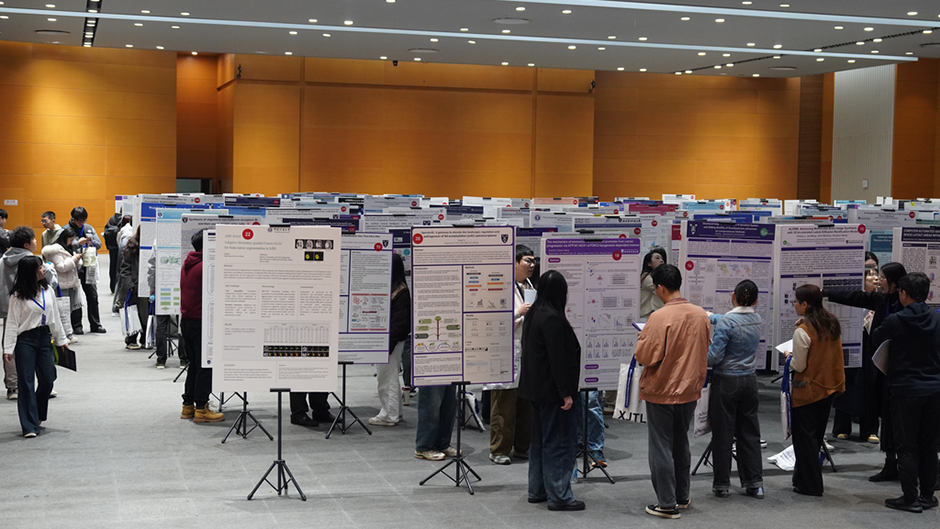
From 19 to 20 March, Xi’an Jiaotong-Liverpool University (XJTLU) hosted the 2026 Postgraduate Research Symposium, bringing together nearly 550 PhD students from 13 universities and research institutes in China and abroad. The event featured 614 presentations, including 329 posters and 285 oral presentations across multiple disciplines. With support from the UK-Jiangsu World Class University Consortium, the symposium provided an international platform for PhD students to present their work, exchange ideas and receive feedback from academics, industry experts, and fellow researchers. Poster presentation at the 2026 Postgraduate Research Symposium The event concluded with an award ceremony on 20 March, which recognised outstanding presentations. According to XJTLU Graduate School, award-winning students from XJTLU will have the opportunity to represent the University at the second XJTU-XJTLU-UoL Doctoral Wisdom Convergence Camp in April. Sharing ideas across borders Raj Roy, a PhD student in Chemistry at New York University Shanghai, says he joined the symposium to exchange ideas with researchers working on similar problems. ‘I don’t believe research is a win-or-lose game. When a problem gets solved, whether by me or by someone else, it’s a win for humanity. It’s a small world in research, and it’s very likely that many people are working on similar problems. ‘Symposiums like this bring such people together, and gives an opportunity to exchange perspectives, discuss different approaches, learn from each other’s mistakes, and have meaningful debates that help move the field forward,’ he says. Raj Roy Roy, whose research explores ways to enhance the effectiveness of radiation therapy, says interacting with researchers from different cultural backgrounds is one of the most valuable aspects of academic events. ‘I believe cultural differences can also have an impact on research, because people from different cultures often have their thinking shaped by different experiences. As a result, they may approach the same research problem in unique ways. Seeing these different perspectives is valuable because it helps us think about problems in ways we might not have considered before,’ he says. ‘AI for Research’ A highlight of the symposium is the themed exhibition, ‘AI for Research’, which took place on the afternoon of 20 March. The exhibition showcased how PhD students integrate artificial intelligence into their research across diverse fields. Lok Hang Cheung, a PhD student at XJTLU’s Design School, who presented at the exhibition, focuses on the application of AI in architectural design. In his view, the emergence of AI has allowed many researchers without a computer science background to cross traditional boundaries. Lok Hang Cheung ‘AI for Research’ exhibition ‘In the past, I mainly explored – on a theoretical level – how designers interact with computer tools. But now, I can spend just a few days building a small application to test whether my ideas actually work. My research now has become inseparable from AI,’ he says. AI is also opening up new possibilities in life sciences, says Yu Lu, a PhD student in biological sciences at China Pharmaceutical University. She studies the molecular mechanisms involved in the initiation and progression of breast cancer. ‘Life science and biomedical research involve enormous amounts of data, from tumour gene sequencing to protein interaction analysis and drug molecule screening,’ she says. ‘Traditional research methods can be time-consuming and inefficient. AI, with its ability to process large datasets and make accurate model predictions, can significantly shorten research cycles and reduce research costs.’ Yu Lu While many see AI as a powerful tool, others also emphasise the importance of reflecting critically on its use. Vladimir Milić, from Serbia, is a PhD student at XJTLU’s School of Humanities and Social Sciences, studying China’s engagement with Central and
Postgraduate Research Symposium showcases global research innovation
Leave a Reply