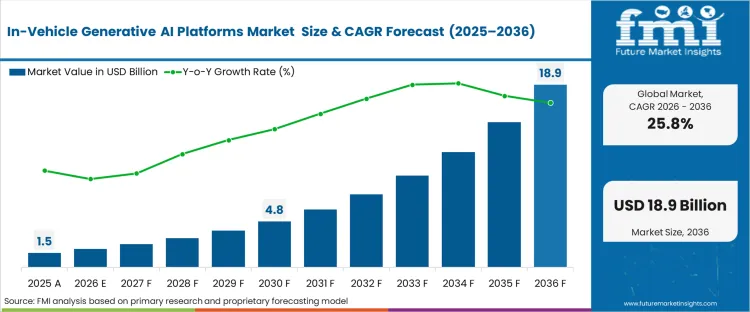
In-Vehicle Generative AI Platforms Market Size, Market Forecast and Outlook By FMI The in-vehicle generative ai platforms market was valued at USD 1.3 billion in 2025. The industry is poised to reach USD 1.9 billion in 2026 at a CAGR of 25.80% during the forecast period. Sustained investment propels the total valuation to USD 18.5 billion through 2036 as vehicle architectures transition from fragmented control units to centralized high-performance compute nodes capable of hosting neural networks for real-time human-machine orchestration. Automotive chief technology officers are no longer deciding whether to include voice commands; they are deciding whether to surrender the cockpit experience to Big Tech ecosystems or build proprietary automotive genai copilot frameworks. The stakes for delay are the permanent loss of first-party driver data and the relegation of the vehicle to a mere hardware shell for third-party software. FMI analysts observe that the true bottleneck is not model intelligence but the thermal and power constraints of edge-based inference within the vehicle’s electrical architecture. Integrating these platforms requires a complete decoupling of hardware and software lifecycles to prevent rapid cabin obsolescence through automotive intelligence. Summary of In-Vehicle Generative AI Platforms Market In-Vehicle Generative AI Platforms Market Definition The market represents the shift from reactive to proactive vehicle interfaces, where generative models interpret driver intent and environmental context to automate complex tasks and personalize the in-cabin environment. Demand Drivers in the Market Consumer expectation for smartphone-parity interfaces forces infotainment designers to replace rigid menus with natural language fluid agents. Increasing complexity of vehicle features requires cognitive assistants to simplify driver interaction with ADAS and navigation settings. The transition toward software-defined vehicles necessitates generative platforms that can evolve through over-the-air updates without hardware changes. Key Segments Analyzed in the FMI Report In-Cabin Conversational AI: This segment is expected to hold 45.2% share in 2026, driven by the immediate consumer demand for intuitive, zero-latency in-car assistant technologies. Passenger Vehicles: This vehicle type is projected to account for 72.5% share in 2026 due to the high volume of tech-driven retail sales. L2/L2+: These platforms are estimated to garner 58.4% share as mass-market vehicles integrate semi-autonomous features requiring AI oversight. India: India leads growth with 32.4% compound growth, reflecting a structural shift toward tech-premiumization in emerging middle-class markets. Analyst Opinion at FMI Nikhil Kaitwade, Principal Analyst, Automotive, at FMI, opines, “The industry is currently caught in a practitioner paradox where OEMs are racing to integrate massive generative models to satisfy marketing demands, yet the actual hardware thermal envelope in the vehicle often cannot support sustained high-token inference. We are seeing a shift where the value is moving away from the model itself and toward the orchestration layer that determines when to process data at the edge for safety and when to offload to the cloud for complexity.” Strategic Implications / Executive Takeaways Tier-1 suppliers must transition from component manufacturing to becoming platform orchestrators to avoid commoditization by Big Tech software providers. Fleet managers should prioritize vehicles with high-performance NPU architectures to ensure generative AI features remain compatible with 10-year vehicle lifecycles. Software developers face a critical need for localized small language models (SLMs) that can operate without a persistent data connection to ensure safety-critical reliability. Methodology The research leverages a bottom-up sizing model based on vehicle production tiers, validated through primary interviews with decision-makers responsible for digital cockpit procurement. In-Vehicle Generative AI Platforms Market Key Takeaways Metric Details Industry Size (2026) USD 1.9 billion Industry Value (2036) USD 18.5 billion CAGR (2026-2036) 25.80% Source: Future Market Insights (FMI) analysis, based on proprietary forecasting model and primary research The structural gate for mass adoption is the
In-Vehicle Generative AI Platforms Market Size, Share & Forecast to 2036
Leave a Reply