Artificial intelligence chatbots are so prone to flattering and validating their human users that they are giving bad advice that can damage relationships and reinforce harmful behaviors, according to a new study that explores the dangers of AI telling people what they want to hear.
From left, Dan Jurafsky, Stanford professor of computer science and linguistics, Myra Cheng, Stanford Ph.D. candidate in computer science, and Cinoo Lee, Stanford postdoctoral fellow in psychology, pose for photos on the university campus March 26 in Stanford, Calif.
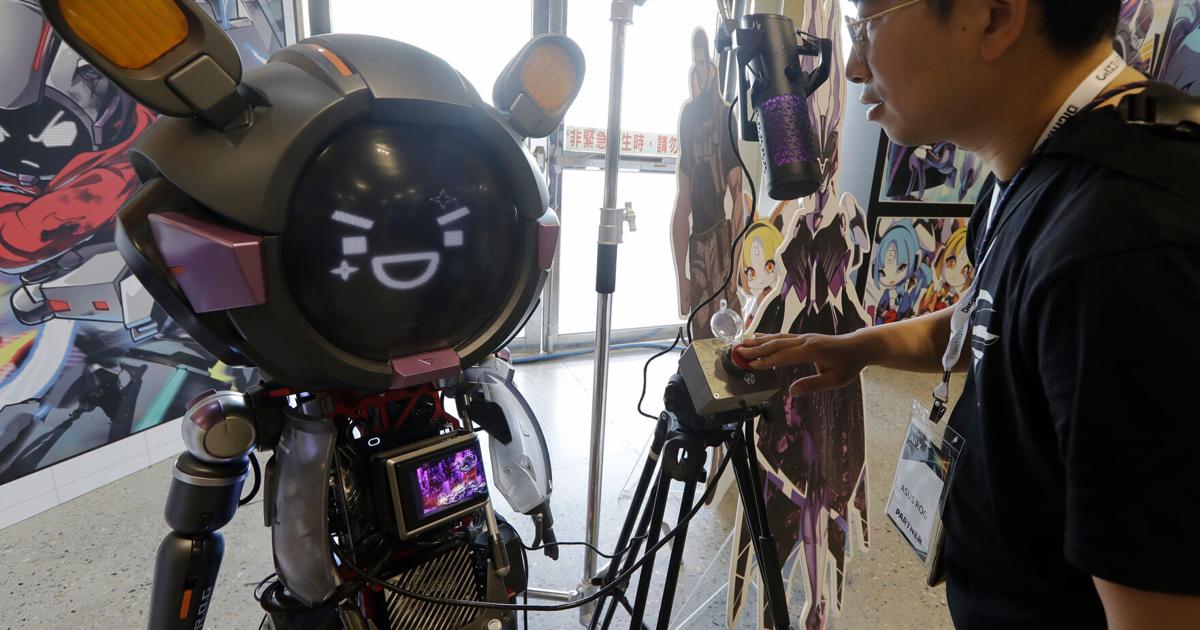
A man communicates with an ASUS Character Virtual Assistant, ROG Omni system during the AI EXPO on March 25 in Taipei, Taiwan.
Artificial Intelligence (AI) is revolutionizing industries at an unprecedented pace, especially in the hard-hit manufacturing space. From supply chain automation to predictive maintenance, manufacturing is experiencing a surge in efficiency-driven innovation.
However, there’s a critical area where AI has barely made an impact: the daily work experience of frontline employees, who comprise an estimated 70% of the U.S. workforce.
Despite being the backbone of manufacturing and logistics, frontline workers often remain disconnected from their employers, underserved by technology, and burdened by outdated or poorly designed digital tools. This investment gap represents a significant missed opportunity for enhancing productivity, engagement, and employee retention.
United Business Mail, America’s largest independent provider of Standard Commingle Services, is beginning to do things a little differently.
“If someone makes it through their first seven days, they’ll likely be here for life. But making it through those first seven days is a major challenge,” says Valentine Chavez‑Gonzalez, United Business Mail’s director of human resources. “Using AI during onboarding could help boost that early retention.”
When Chavez‑Gonzalez first came to United Business Mail, their attrition rate was 150%. Now, attrition is three times lower, thanks to a lot of hard work and leveraging AI-powered workforce management software.
But United Business Mail’s story is one of the exceptions.
“We sort between 19,000 to 33,000 pieces of mail every minute,” notes United Business Mail CEO Bill Boyce. “To keep that pace, everyone has to be on the same page. The company’s employee-centric AI helps us be 50% more productive and operate in lockstep. It’s our secret ingredient.”
The natural next phase of AI adoption in manufacturing is to go beyond automation and empower the people doing the work. It also has to be safe.
“One of the reasons we felt confident using our AI employee assistant is that it uses our own data as the source,” Chavez‑Gonzalez says. “That’s unique. Most policy assistants pull from generic external sources,”
Companies serious about retention, productivity, and workforce engagement will benefit from prioritizing the employee experience, not just process optimization.
This means investing in:
AI is ubiquitous—but if manufacturing leaders don’t reconsider how they apply it, they risk neglecting their most valuable asset: the workforce that keeps everything running. As Chavez‑Gonzalez aptly puts it, “HR doesn’t work 24/7, but our AI does.”
This story was produced by TeamSense and reviewed and distributed by Stacker.
AI is giving bad advice to flatter its users, new study says
Leave a Reply