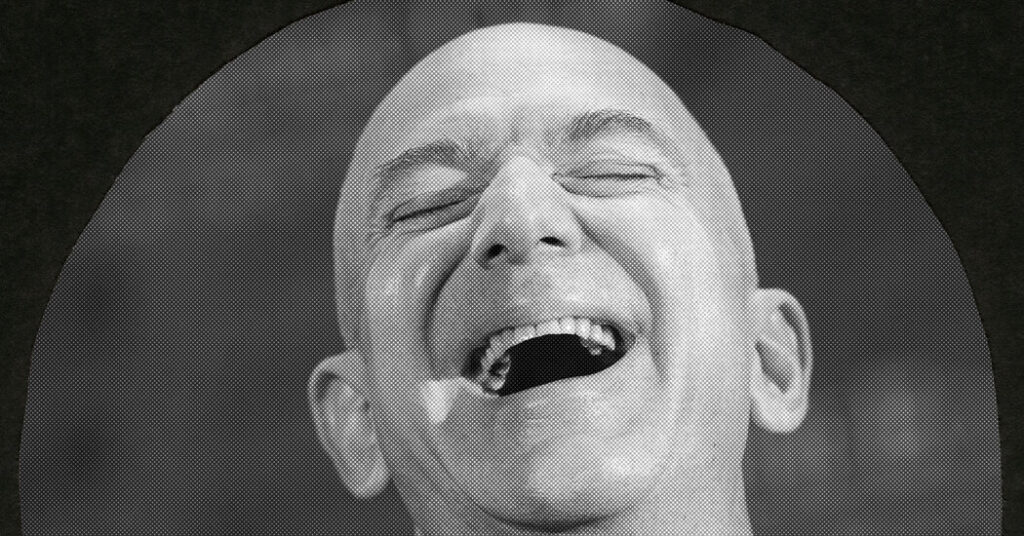
In June 2017, in one of those strange turns of life, I found myself at a dinner in a palazzo in Turin, Italy, sitting next to Jeff Bezos. We had both been invited to speak at a conference convened by an Italian billionaire to discuss the future of newspapers, I as the editor of HuffPost and Bezos as the owner of The Washington Post, which he had bought four years earlier. I was surprised and, I’ll confess, a little delighted to find myself alongside the man of the hour. Bezos had cut quite a figure at the conference — offering a passionate case for plowing more resources into the heart and soul of the newspaper he pledged to rebuild. ‘What they needed was a little bit of runway and the encouragement to experiment, and to stop shrinking,’ he said of The Post’s newsroom. ‘You can’t shrink your way into relevance.’ Under his ownership, the paper had added about 140 reporters and rounded the corner to profitability on the back of its journalists’ verve in breaking big stories. This was music to my ears. It had been an especially bruising month for the industry, and hundreds of journalists had lost their jobs. I had been asked to slash the staff of HuffPost, which I had joined six months earlier, as part of a cost-cutting exercise tied to our parent company’s acquisition of Yahoo. For reasons I could scarcely understand, the deal required laying off 39 journalists, along with more than 2,000 other employees. Yet here was one of the richest and most celebrated business titans in the world urging the opposite course. As we dug into our sumptuous meal in an ancient hall filled with media grandees, I made a nervous, self-deprecating crack about being a cynical wretch out of place amid the splendor. Bezos quickly corrected me. Great journalists, he said, were not cynical. They were skeptical, as they should be. I offered up a sheepish grin, charmed to hear him echo the credo of my earliest, most grizzled newsroom mentors. Maybe, I thought, this guy was worth trusting. Turns out the joke was on me, and on journalism. Last week The Washington Post laid off nearly half its staff — according to a recent accounting from the newsroom’s guild — removing brave foreign correspondents, axing its celebrated sports section, gutting its metro reporting staff and more. The cuts, the paper’s leaders said, were aimed at stemming losses and enticing Bezos to keep investing. The paper was, in other words, attempting to shrink its way into relevance — not with its audience but with its unfathomably wealthy, highly distracted owner, whose fortune has more than doubled in the nine years since I met him. Its newly unemployed journalists, by contrast, face a bleak job market, as their colleagues and friends pass a digital tin cup to raise money to support them. This wanton destruction took me back to that encounter with Bezos. Why, I wondered, had I trusted him? Trust is an elusive quality nowadays, seemingly vanishing from public life. That disappearance is particularly acute in news media, as new research this week from Pew underscored. An analysis of polling found that 57 percent of Americans ‘express low confidence in journalists to act in the best interests of the public.’ On its face, this looks like an existential problem for journalism. What good is reporting the news if people don’t trust it? Restoring trust, everyone tends to agree, is a worthy goal. But in an age of digital platforms, algorithmic filtering and declining media literacy, there is no simple recipe
Leave a Reply